Thursday, 25 August 2016

These are my hands.

I found this poem several years ago, and it is the inspiration behind my logo drawing. Hands are the tools of our midwifery trade. To have them simply poised for action is a tricky skill to learn. Unlike other pieces of equipment in our workspace, we don’t spend wasted minutes running around the corridors trying to find them. We cannot be made to share them around and they’re rarely sent for repair, to be missed for weeks on end. What’s more, they’re relatively inexpensive.
The joy is that our hands belong solely to us. They are attached and cannot be removed from us. In the remotest corners of the world, our hands can save lives, hold space, and nurture women, babies, and families. If we have absolutely nothing else, we can still do our work.
Admittedly hands, like any other tool, are only as good as the midwife using them. Hands are team players, and completely depend on our eyes, ears, head, heart, and soul. Maybe Aristotle knew back then that a midwife, who worked with the whole package, had the strongest essence for being with woman.
And so....
Our hands are our tools. Let’s honour them. Let’s keep our skills and practice them hard. There may be a time when we find ourselves with nothing else, but we will still be midwives.


“These are my hands. Through these hands I have come to see the world. 
These hands have measured the growth of life and documented the stalling of time. 
They guide my ears to places where I hear the watch-like beat of tiny hearts. 
My hands have felt the hard bony framework of passages and the softness of muscles 
Which will bulge like petals of a rose. 
My hands have opened windows to the energy of the souls of those I have touched. 
They have held the frigid rigidity of steel instruments and the softness of a friend. 
There are stories in these hands, read from the pages of the work of women. 
With my hands I felt the power of the strength it takes to grow and release new spirit. 
My hands were born with the knowing of touch. 
The journey has added how and when and the time to ask for help. 

Teaching hands engulfed mine until they were ready to fly. 
My hands are joined in a circle which is unbroken through time. 
Sometimes my hands do nothing; Their most important work will be still with fingers laced 
and witness the 'art of doing nothing' has been passed from one generation to the next. 
Mine have been taught by some of the most powerful hands, to watch and wait. 
This is perhaps the hardest for hands born to touch. 
If I have nothing else to give you, let me teach you how to see with your hands. 
How to open the windows of life, and close the door softly when it is time. 
In the darkness, it is your hands that will light the way. 
These are my hands. 
These are the hands of a midwife.”

Hands- Jan Weingrad from the book 'The art and soul of midwifery (Davis, L)


Thursday, 14 April 2016

Letter to RCM: A sad day.


Dear Royal College of Midwives,


When I qualified as a midwife, I didn't feel that I needed a graduation ceremony. I was a mature student, with a grandmother born on Halloween 1900 and a midwife for her whole career, my training was always on the cards. It was only when invited to attend a meeting to discuss the up and coming 'Global Midwifery Twinning Project' (I was already involved in Nepal), and I stepped up towards the huge blue door of RCM head quarters, that I truly felt I'd 'earned my colours'.


I'm proactive and incredibly passionate about midwifery, both at home and overseas. Like you, I am keen for midwives to have a voice and a future. Being a member of RCM has been one way for me to support this.


However, I have found it necessary to secure more union support than you can offer..... for my overseas midwifery, my volunteering midwifery, and my independent consultancy midwifery. I'm sure you'll not have missed the fact that all of these ways of working are vital to keeping midwifery available to all, and help to protect what autonomy we have as midwives.


Please will you end my membership from today onwards, as I have had to start union cover with Royal College of Nursing. They will provide, and for a smaller fee, professional indemnity cover to include all of the above activities.


I'd like you to know that I have hated the thought of ending my membership. It feels so wrong, and I'm deeply saddened. I am also quite angry that Royal College of Midwives are unable to support me and protect me while I help to take midwifery 'out there'. It matters to me, it matters to our profession, and it matters to women. I don't doubt this isn't the first letter you've received on the issue, but I'd love it to be one of the last. I also appreciate there are likely to be numbers, funds, and other restrictions in place for RCM, and I'd love to know your reasons for not fully supporting midwifery. I'll be back, quick as a flash, if you change your provision of support and cover.


Mostly, I need you to know that I'm gutted. I feel strongly, and need you to appreciate that. And lastly, I want to thank you for support you have given me until now.


Sincerely,


I received a standard formatted reply from RCM, rather than a personal one, which didn't explain why they couldn't support me.


I feel let down.


Sunday, 6 March 2016

Penny for your thoughts....

I was just considering updating where I'm at with my midwifery and travelling. I'd hoped to get a more personal reflection of my findings and usefulness after the Dunkirk trip, but I've been thrown into preparations for another pending trip to Nepal. Hopefully, I'll spend some time with colleagues over the next two weeks, and we'll share experiences, challenges, high and low points of our midwifery volunteering in France, and where this might lead us.


Other events demanding my attention are International Women's Day on march 8th, International Day of the Midwife on May 5th and, as mentioned, a trip to Kirtipur, Kathmandu on 2nd April to support the opening of a Normal Birth Unit. Busy!


I'm writing right now because I'm intrigued to find out who is doing all the sharing of my blog. It's had over 2000 hits, from France alone, in the last few days. Who are you, and what are your thoughts? Midwives, legal, political, humanitarian always, as well as polite. I'd love for you to share in the comments, below. You might just have to add your name as 'anonymous' in order to post, but feel free to include your name when you comment. Thank you.

Monday, 8 February 2016

Another fun and messy evening.

Practical Crafts Evening.
Beginners welcome.


Tuesday 15th March, 7pm til 9.30pm. Kirtlington Village Hall.
Tickets £20.


Select from drop spindle spinning, basic knitting/crochet, woodcarving, pottery, and glass/wood/pebble painting. Ticket includes sessions at 2 work stations of your choice (First come first served), a glass of wine or a cuppa, and nibbles. All materials are included and you’ll have your own masterpiece to take home.
Proceeds will go towards

Midwifery needs in Dunkirk Refugee Camp.


Thursday, 4 February 2016

'With Woman', and much more, in Dunkirk Refugee Camp.


So, first trip to Dunkirk refugee camp is out of the way. Much learning and processing is still to be done, though. This sprawling of findings feels like I'm sifting through a tin of spaghetti alphabet letters. In order to explain to another, I need a level of understanding myself, and I don't yet have that. But I CAN tell you of the practicalities, and with so many midwives considering getting out there to support the refugees, this is good enough.

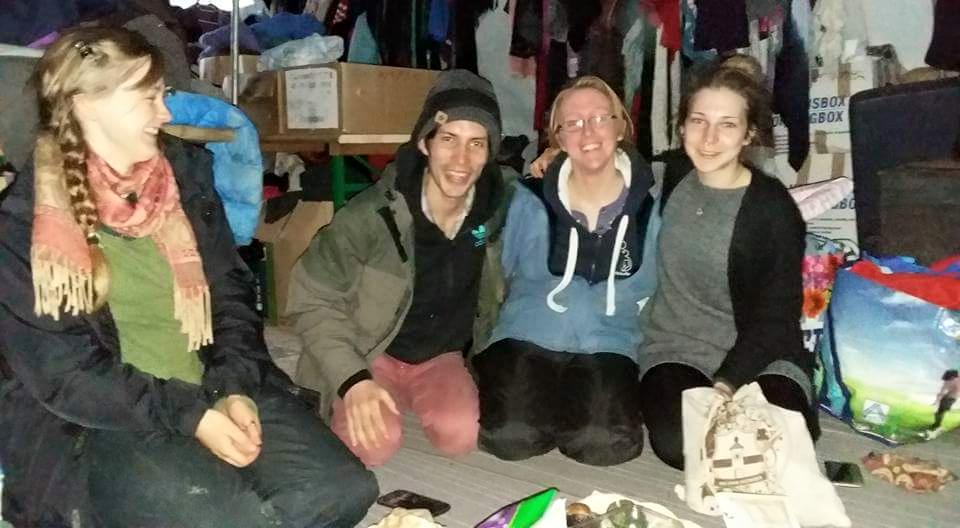
The team. A mix of characters, but we worked really well together.
Thank you, Maggie, Verity, and Sharon, for joining me.


Practicalities of the trip

Obviously, up to date passport, E111, travel insurance. A few euros are always handy, too.


Channel tunnel

Cost £154 and shared by the four of us, booked on line (see channel tunnel bookings). Ferry is much cheaper, and takes about 2 hours. Needed to put passport details of fellow travellers online. We got to the tunnel quite early, after leaving plenty of time to travel down to Folkstone, and managed to get on the earlier shuttle. You need to get there 30 minutes before. Actual time in the shuttle was about 35 minutes.


Driving in France.

Verity, amidst all the donated goods.
I checked my car insurance covered my driving in France. In fact, it covered anywhere in Europe for 30 days. I bought a bag full of the necessary car accessories for driving in France (GB sign, headlight diffusers, two breathalyser tests. Spare bulbs, a small first aid kit, a warning triangle, a high visibility tabard....but you now need one for EVERY passenger. Fire extinguisher is advised but not compulsory) by last minute online shopping. I filled my car with fuel when I left home in Oxford, and didn't need to fill up until I got back into UK. So, fuel for the duration of our stay cost us around £70 tops.


The sat nav was so helpful, and I'd already copied out maps of where we needed to go. However, there wasn't very clear info on finding the actual camps. Having three mates in the car who relentlessly shouted 'On The Right' to me, meant we got there and back in one piece. The most challenging times were giving way at roundabouts, and coming off them, flowing onto a dual carriage way (because you can't easily see with a right hand drive car) and moving out of or into junctions. Talking myself through where I planned to drive, while I was doing it, helped all of us stay focussed. I did have to turn around at one point, because I'd missed a turning. When I pulled back out, I was briefly on the WRONG side of the road, and moving towards the right turn that I'd missed. I totally ignored the panicked shouts of 'On The Right'. I thought they were over zealously telling me where I needed to turn. Hairy moment, but the only one. I found I quickly became accustomed to it.


Hotel

We stayed at the Premierre Classe Hotel, Rue de Lac, Armbouts Cappel, about 7-8 minutes drive from the camp at Grande Synthe (look up Boullevarde Pierre mendes). The rooms had a double bed and a single above. The bathroom was small but always had fiercely powerful and hot running water in the showers. The beds were comfy. For the price of £136 for five nights, the rooms were very good value. Breakfast was a pretty basic affair, with bread or cake, yogurt, juice and coffee.

For our evening's meal, we crossed the road to the Quality Hotel. Nice food, and wine. But they don't serve food on fri/sat/sun evenings.


Provision of maternity care in Dunkirk camp.

Medicins sans Frontieres have now been welcomed to provide care in the Dunkirk camp, and are there up to 7 days a week. Medicins du Monde are now there Thursdays and Fridays, and Gynaecologiques sans Frontieres are also there Thursdays and Fridays.

These guys are able to provide first aid maternity care for women who present at their caravans. Beyond this, the women, and anyone else needing further treatment, have to get to the local hospital. There was understandable frustrations within the teams, with the amount of care they were legally able to provide.

Touching base with MSF. Communication is important.


Many women are afraid of venturing out, and there is a level of mistrust towards the NGOs. Several pregnant women are known by MSF and the various voluntary organisations, but there are undoubtedly some that are unknown to the support workers, and of course there will be new pregnancies. Some more vulnerable women are removed from the camp, and placed in hotel settings or 'plasitc' housing. It was never made clear how these women access their maternity care, or who has details of their whereabouts.


Professional regulation

Not quite midwifery, but valuable all the same.
In order to practice full midwifery skills, we are required to have professional indemnity insurance. NHS covers us for our work within shift and trust time only. Royal College of Nursing, and maybe Unison(?) provide cover for some care, but not all, and certainly not intrapartum care. Royal College of Midwives cover for 'Samaritan' care only (see below).


Maggie doing a brilliant job
 in the 'shoe department'.
In order to practice midwifery in France, you also have to be registered with the French Medical Council. They cover slightly different aspects and, understandably, mastery of the French language is a necessity.

The most convenient way of providing midwifery care in the refugee camps, would be to work within an organisation (NGO). However, in order to get insurance cover, training etc, you'd have to commit to maybe three months continuous work with them, and most NHS midwives would actually have to say goodbye to their regular jobs in order to work with the NGOs.


So, what does this mean for me, as a UK registered midwife? I'm not in a position to be able to leave my job and take up a nomadic and uncertain life with the medical NGO's. I'm not either, at this point, prepared to jump through hoops to become a 'French' midwife.....


I believe many midwives are out there simply 'doing their bit'. They are providing emergency care, midwifery based or not, and are working without the support of their country or union. Yup, dodgy, but definitely raw humanitarian work where and when it is needed most. Bless them, and what a crying shame they're not getting the support they deserve.


Over the next few months, I wouldn't be surprised to see a few more positive statements creep out of the woodwork. Mostly, midwives are caring people. Why wouldn't they want to support this dreadful crisis? Legally, or illegally, they're going to help. It would fill my heart with delight to see the Royal College of Midwives providing some kind of support. Maybe there will be a statement posted soon, on their website explaining their position.


There has been debate over exactly what constitutes emergency or Samaritan care. When pushed, the RCM provided this definition....


'The policy provides for claims arising from a good Samaritan act however it is important to note that a Good Samaritan act is where medical services are provided at a scene of a medical emergency, accident or disaster who is present by chance or in response to a medical call. '


The finer detail of 'present by chance' isn't really fine enough, in my mind. It left me thinking if there did happen to be a maternity emergency, I'd be better off walking in the opposite direction, in case there were repercussions. This is wrong on all levels.


Other tips to share.

There is no legal advisory organisation that I know of, working within the Dunkirk camp. The refugees could REALLY do with this. They need to be supported to move on, and have choices regarding safe transit, asylum, and funding during this process. So many are still in camp because they don't know what to do next. They are sitting ducks for yet more trafficking.


Getting past the police into camp was problematic only on the last day. We were advised we'd have to go to the town hall to request authority for access, but they then 'allowed' us in, after check all or our passports (midwives are such a dodgy gang!).


Our small team of midwives spent much of our time in the Women and Children's Tent. This seemed a pretty sensible place to hang out to get conversation started, support women emotionally, with advice and education about any issues these women had. Sadly, it's probably only the more confident women who were accessing this tent, and until word gets around that midwifery support is here, we'll have limited knowledge and access to the more vulnerable ones. It would be great to have midwifery presence on a regular basis, so that we can venture into the 'woods'.


If you're a midwife planning on going over there, be prepared to support generally. Litter picking, taking people to the hospital, gathering provisions for people, help support the new school. Vaccination programmes for measles may be up and running and you might like to help out with that. HANDS, NGO, seem to be organising this. Stay in contact with MSF etc, as these guys will be in the 'know' of recent events.

Risking life and limb (mostly limb) to get to the Women and Children's Tent.
If you want to support the Women and Children's Tent, there are a few simple ground rules. The aim is to supply women with clothes etc, and for them to collect what is needed in a safe manner. Men in the tent is a 'no-no'. Men hanging around the tent is discouraged. Only three women at a time in the tent (as some more sought after provisions disappear very fast!), children need to be accompanied. Ethos is to take only what is needed (ie, not taking half the shop in order to sell it on..). Put your personal belongings behind the 'no-go' area, or they WILL walk. Remember the guys in charge (currently Adrian and Svenja) are volunteers, too, and you're sharing THEIR space. The door opens at 11am, and closes at dusk, or when quiet.


With Adrian and Svenja, catching up after a lovely
lunch that DIDN'T consist of rice.
There IS a box labelled 'Maternity' at the back of the tent. It has multi vitamins, Iron, UTI treatments, condoms, pregnancy tests inside. We could do with Vitamin D, too. These are all 'off the counter' preps. Any translations/ communication aids can be left here. Over time, it is hoped that women know they can seek the more social/ educational aspects of midwifery support in this tent, and it can also be a base for volunteering midwives.


Cards, with Kurdish writing on the reverse, to help
 educate about pregnancy complications.
There is not enough women's leggings, jogging bottoms, sleeping bags, hair brushes, conditioners, wet wipes, small packs of tissues in the Women's and Children's tent. If you're planning on going, take provisions straight there. Do not pass Calais. Go directly to Dunkirk.


In time, there may well be a new 'Women's Tent' erected near the current tent, where women can go to cook etc. Maybe this will have more space to 'be', as supporters. The idea of a 'knitting tent' has gone. There isn't enough stability, currently, to keep this a 'safe' place.


There are many volunteer groups on Facebook etc. It's a good idea to make yourself known to a team and ensure somebody knows where you are. Loads of support is around at the weekend, and the place feels quite different. Help is best coordinated, and projects, current needs, and concerns (there were shootings in camp on the day we arrived, and demonstrations/ tear gas use on another day) can be passed about very quickly. Every day is different. More hands make less work...only by collaboration and communication.

In limbo...and an awful lot of mud!


I apologise. This is a rather sullen and humourless post. I found nothing to joke or get excited about (Best I don't mention the many firm bums in the blue Gendarme trousers every night at the hotel). The apathy and lawlessness in the camp was a real eye opener, but it was present alongside the many dreadful stories of basic survival of the fittest and the lucky. What some of these people have endured to get to this point beggars belief.


So, this is as much as I can give at the moment. Frustration, anger, disappointment, sadness...doesn't become me. I shall jiggle things and ferment ideas until I can come up with a wholly more positive picture, and update.


An answer to this whole sorry state would be good, but while the world makes noises about getting it's act together, we'll just carry on caring.


Monday, 11 January 2016

Midwives for Refugees.


Give me a spare five minutes, and I can always think up some trouble. I've been up all night with a birthing woman, and my brain is now at half mast.....but functioning enough to wander in and out of sense. This means it's able to explore opportunities I'd otherwise know better to avoid!


Lately, I've been exploring the possibility of getting out to the French refugee camps in Calais and Dunkirk. There's not likely to be too many pregnant/lactating women, but it would be nice to offer them midwifery support. Working with NGO's generally means setting aside quite a chunk of time away from family and NHS work. This isn't possible for the majority of midwives. To go out to France, or even Greece, for just a few days, is far more manageable.


Take the idea of a few days in camp one step further....and it grows into a rotation of UK midwives, maybe every two or three weeks, providing on-going support, that doesn't eat away at annual leave or expenses.


Here lies the problem....


To practice in UK, midwives have to work completely under the 'protection' of NHS, or have professional indemnity insurance. Many are members of Royal College of Midwives, but RCM don't offer any cover. Royal College of Nursing has some amount of cover included in it's membership, and this includes some overseas volunteering.


PI insurance would be necessary to practice in France, but we also need to be registered with the French Medical Council...I think. There has been noises that this is not too difficult, but French language is a pre-requisite. There is also the possibility that registering is not necessary for short term voluntary work. I'm awaiting a definite answer from them.


It's also possible that, under EU movement of professionals, there maybe some protection and possibility for us to provide midwifery care without being registered. I'm awaiting more information on this.


I have requested, as a member, that RCM's legal department checks out the situation of UK midwives providing care in France. I'm awaiting the response.


Lastly, the question of MSF (and the like) considering taking a core of our rotating midwives, who are prepared to commit to a certain time over the year (and in short spells rather than a long one), under their umbrella and insurance, has also to be answered.


Lots of waiting, eh?


And while I wait....midwives, doctors, nurses are already out there helping people out, and mostly just providing the most basic of first aid care. Some are working with the NGO's. It's good news that MSF have recently been invited into the Dunkirk camp, which looks to be in a dire state. Other healthcare workers have just gone out there to see how they can help, regardless of legalities and registration. Most will understand that providing anything other than first aid care, or showing an 'intention to treat', leaves them open to trouble. All this red tape, just to care for people in an emergency situation. I envy the guys who will go there regardless, and I NEVER thought finding out exactly what we can and can't do, would be so incredibly challenging.


It is evident, regardless of provision of clinical midwifery, that more caring hands and hearts are needed. The essence of midwifery, and quite possibly most important to those in the camps, is being 'with woman'. Throwing a tantrum that I can't assess for hypertension is simply a symptom of what midwifery has become in our minds and our NHS. First aid care for women who have travelled away from, through, and arrived at varying levels of hell, requires compassion and kindness. Thank goodness those skills aren't yet regulated.


So, 26th January it is! I'm still not sure on numbers. One or two cars, maybe a van, ideally filled with necessary provisions, and heading most probably to Dunkirk. Another team will go out middle, maybe end of February. Things in Dunkirk are extremely fluid at the moment (in more ways than one, given all the dreadful rainfall), so a destination plan will stay fluid, too.


Now, add to that plan of rotational midwives, as yet unable to offer a full compliment of skills.....


.......a large family sized tent where women can come together in the daytime to knit and crochet donated wool into 20cm squares to make blankets, or whatever they want to make.....


......and you can address many issues all at once. Community. Empowerment. Positivity. Skills at crafts. Warmth. Language skills. Contraceptive advice and supply of condoms. Pregnancy tests. Info on domestic abuse and rape. Breastfeeding retreat....and the list goes on.

The tent can be made safe by it hosting a couple of women living there as 'housekeepers'. In any community there are wise women, and I've no doubt we'll quickly identify those who would like to support fellow refugees in this way.


20cm squares, knitted or crochet

I'm not sure I'll be able to get a tent into Dunkirk camp just now, but I can take one and store it, along with furnishings, for when access is able. It will become clear where is best to set up more long term. There's nothing to stop small groups of women (and children) learning to crochet, during my first trip. People are naturally interested, and often want to at least have a go for themselves. So, along with provisions of clothing and medical supplies, I will take wool, already made up 20cm squares, and hooks/ needles.

The less talked about skills of midwifery.
The facebook page 'Midwives for refugees' was set up to share any information for UK midwives thinking to support refugees and migrants with voluntary reproductive healthcare. In three weeks, it has more than 200 members. It's fantastic to find so many midwives are so eager to help.


Thursday, 7 January 2016

First Taste of Africa.


So, a new destination and a new adventure. Some different slants on old stories. Some conquered challenges for them, some new challenges for me, but always challenges. After all, we'll never bring change if we don't face a few challenges. All together, eight leaders, thirty two eager-to-learn carers, all eating, drinking and sleeping maternal and newborn health.
YAY!


This latest trip took me to Kenya. Third time lucky after a couple of cancellations, and the first time for me on African soil. Funded by the Centre for Maternal and Newborn Health at Liverpool School of Tropical Medicine, a retired obstetrician called Richard Kerr-Wilson who is rather more used to African ways, and I travelled out to Nairobi. It was a flying visit (ho ho), whistle-stop tour to deliver obstetric emergency care training, the CMNH way. Packing for way up in the hills (read emergency rations of individually wrapped cheeses and dried fruit/nuts) was quite unnecessary, so I filled my case with more frivolous provisions. I won't go into details here. A lady's case is quite a private affair ( until you get to British Airways security, that is...) but my case was embarrassingly heavy for such a civilized trip.


What did I worry about? I worried what kind of food they'd dish me up, being vegetarian n'all, and whether the accommodation would be isolating or at all scary. I worried how I'd get on with my travel companion, but only slightly, because midwifery depends on the ability to make quick connections, and my companion was a joy to be with. As my flight was the morning after the shootings in France, I worried about the return flight into UK and any security issues developing from that. But so many untoward events have happened just before my flights, and isn't that the safest time to fly?


Nairobi looked quite smart, but we only saw the smart bits, apparently. Our hotel was very nice, and having shared photos with friends, I suspect it's often frequented by UN and UK workers. I'm wasn't sure if all the security barriers made me feel more or less secure. Sharing breakfast with a fellow traveller who grew up in Nairobi, and hearing her stories, was enough to reassure me that security is indeed GOOD.


My first taste of 'Africa' was in the back of a car, through blackened windows. Not wanting to miss ANY of the scenes, I wound the window down and had the warm air whistling around my neck. The great Rift Valley, as it came into view with splashes of sunshine sprawling over it, was like something out of the 'Land Before Time'. It looked amazing, and I valued the reduced responsibility of having to make pleasant conversation with the rather quiet driver.


My first view of wildlife was not really so wild. A small herd of Zebra, and a few baboons sat by the tarmac roadside, with concrete box houses and electricity pylons in the back ground. It didn't quite live up to my expectations. I was mildly disappointed as well, that the shanty areas looked all too familiar to my experiences in other lands. The tidy rows of endless 'garage' size homes, all with TV antennae, were an improvement on the tarpaulin used in Nepal. But had I moved off the track, I suspect findings would have been more disturbing.


Nakuru itself was flat, tidy, and fast flowing, criss-crossed in straight lines like scars (or birth marks, I'm not up enough on the politics and history to decide which) from the army's influence. The town has apparently grown massively in the last few years.


View towards the lake, from my room.


The bed during my stay was comfy enough. There were wonderfully helpful housekeepers. The restaurant was pleasant, although staff were slightly perplexed by their non-meat-eating guest. Neighbouring dogs and passing lorries made for disturbed sleep, at times. I didn't see one mosquito, but a more than adequate net was at the ready (to hang me at any opportunity) and, oh joy, there were no midwife eating spiders. Not even little ones.

My time in the bathroom should have been luxurious given this HUGE relief (and huge caseload of goodies), but the showers were cold or, at best, tepid. When visiting Nepal, I've returned and cried into my hot shower in appreciation of such luxury, and felt so blessed for running water. But I have to confess, as I stepped under that piping hot flow at home this time, I yipped and giggled. The difference? May be no difference, but simply that I'm getting rather spoilt. I only just touched the surface of the struggles in Nakuru. Why should I have expected hot water?


The course accommodation was a rather quirky hotel/ function place. The four breakout sessions after each lecture/ demonstration were held in corners of the same room, and this worked very well. Some of the sessions were specific to Kenya, and I have to say, those Kenyan facilitators were the best people to teach them. I certainly learnt more about HIV protection and aseptic techniques. They have 'hand washing' procedures off to a T.


I loved the impromptu additions of little bit of rhythm and quite a lot of laughter to help drive home the learning. By the amount of leg pulling in my direction, I suspect the team members had never met a 'Veggie', but it was a great ice-breaker and made me lots of friends. The waiters were vigilant in pointing me to my daily source of protein.


Without exception, all participants were there to learn. They weren't just there because they were ordered by bosses to attend. There were some thought provoking (read scarily concerning) moments, and beautiful conversations along the way.


Learning was a two way thing, and with this project, it's measured by testing participants before and after the training, and then visiting the workplace some weeks later, to see what knowledge they have put into action.


Teaching WHO partograph. The guy in the
yellow Tshirt was a Midwife, and extremely
 wrapped up in his 'caseload woman'
Time keeping is always a major issue, especially on the longer training days. It's important for the participants to move swiftly around each of the four work stations, as most stations are allocated just 20 minutes. Anne, our time keeper, had the patience of a saint.


I find teaching the WHO Partograph so rewarding. It's where the real midwifery skills come into play, and emergencies are then avoided. I was impressed with the group's ability to define positions of baby from the presenting part, and their understanding of the three 'P's (power, Passenger, and Passage).


It wasn't any surprise to find myself BANGING on about

….Neonatal resuscitation.

….....Golden minute for baby.

….Encouragement of Mum's own birth hormones.


In this medicalised world of child birth, we don't often enough allow Nature to work FOR us. It should be a basic understanding that if there are limited drugs available to prevent postpartum haemorrhage, you do everything in nature's book to encourage a good maternal hormone response. Yet, we overlook the obvious, or don't get taught it in the first place. Protected time for baby on mother's skin straight after birth will impact on baby (and Mum) for months to come. ABCs of neonatal resus are so simple, but moving onto chest compressions before getting air successfully into the lungs, is pointless, AS is leaving a baby in a wet towel. These things are so simple to perform, when understood.


And, as ever, perineal suturing methods left a lot to be desired (excuse the pun!)


When I travel with the LSTM maternal and newborn health team, I'm providing emergency care training, but I do not believe it can be in isolation from good midwifery. While lectures don't always lend themselves to this, the follow up conversations can explore best and safe practice in midwifery.


This teeny baby, fifth in line to his family throne, was born at 36weeks.
Fast labour. Sent direct to neonatal Unit, to share a resuscitaire in the
 office with three very poorly babies. I think he'll have been fine.


On the last day of the course, Richard and I were lucky enough to be shown around the local hospital. It was sparse, but clean. I felt awe at what they were achieving with such few resources. Two women to a bed, even very poorly women. The delivery area was so cramped for space, even if there were staff for emergency procedures, I'm not sure how they'd fit in. Polythene sheets on a simple couch. All couches facing the door, meaning women were overly exposed. When they had so little, how could I suggest dignity should come into the equation? But it should.


Growth restriction and prematurity seemed to be the order of the day (two themes factoring greatly in the new Sustainable Development Goals), and the maternal mortality rate has started to increase, though they are not sure quite why.
Kenya has managed to reduce it's maternal mortality rates from 584 to 510 in 100,000 (World Bank figures) in just four years (UK figure is just 9, to give you some perspective).


Visiting the neonatal unit was by far the saddest part of my hospital trip. A third of all babies don't go home. Having said that, I saw the most scrummy...and almost healthy...42 day old twins born at 28 weeks gestation. They were having skin to skin time with their mum. That is the most amazing little story. How does that happen? And how are they now? I dearly hope they've made it home.


This is a busy unit, with 25-30 births a day. C section has reduced lately from 15 to 12. That's fantastic news. It worries me what these mums will do next time...and the next time...after section. Hospitalisation isn't the only answer. We need more midwives.


Wish I'd seen this work place before the course. (Take note, LSTM)


And...how could I go to Africa without visiting the parks? On the last day we visited Nakuru lake. I didn't expect the place to be so lush. A fresh carcass showed evidence of lions, but we weren't lucky enough to see them. There were just a few pink flamingo on the lake, because it had recently 'shifted' after volcanic plate movement, and the water was too deep for an adequate algae supply. The flamingo had flown to find tastier soup. We spent quite a while on the boggy peat, among the graveyard of trees and amazing bird sounds. It was incredibly moving, and the peace was breathtaking after such a busy and demanding course.


And then Home. Too soon. Great trip. Such potential for even better obstetrics and midwifery. And such lovely warm people. More friends. More learning.
Thank you.